Gift Wrapping Tools and Accessories: The Complete Guide
Last updated: October 21, 2026
Quick answer: for most homes, 4 core items are enough to make wrapping noticeably easier—scissors, tape, double-sided tape, and a cutting surface. If gift wrap keeps tearing, curling, or looking lopsided, the problem is usually the tools, not the paper. The fastest way to improve wrapping is to choose a few right accessories and skip the rest.
A good wrapping setup is about control: a sharp cutter, a flat cutting surface, a tape that actually holds, and a way to make bows, labels, and boxes look deliberate instead of improvised. This guide to gift wrapping tools and accessories is for the person who wraps more than one present a year and wants cleaner results without buying a drawer full of clutter.
I write about packaging, paper goods, and presentation systems, so I care about the small details that change the finished package: blade style, tape strength, cutting mats, ribbon behavior, and storage.
Key takeaways
- The most useful gift wrapping tools and accessories are not the prettiest ones: a cutter, a ruler or grid mat, and quality tape do more for the finish than novelty gadgets.
- Buy for the paper you wrap most often. Thin tissue, glossy paper, kraft paper, and fabric all need different handling.
- A wrapping station works best when it reduces steps, not when it adds more tools.
- Most beginners need fewer accessories than they think: box cutter, scissors, double-sided tape, ribbon, tags, and a storage bin are enough.
- The wrong tools waste paper, fray ribbon, and make corners hard to square.
- If you wrap large gifts often, a paper cutter or wrapping station matters more than decorative accessories.
- If you wrap only a few gifts a year, concentrate on tape, scissors, and storage, not specialty gadgets.
What gift wrapping tools actually matter?
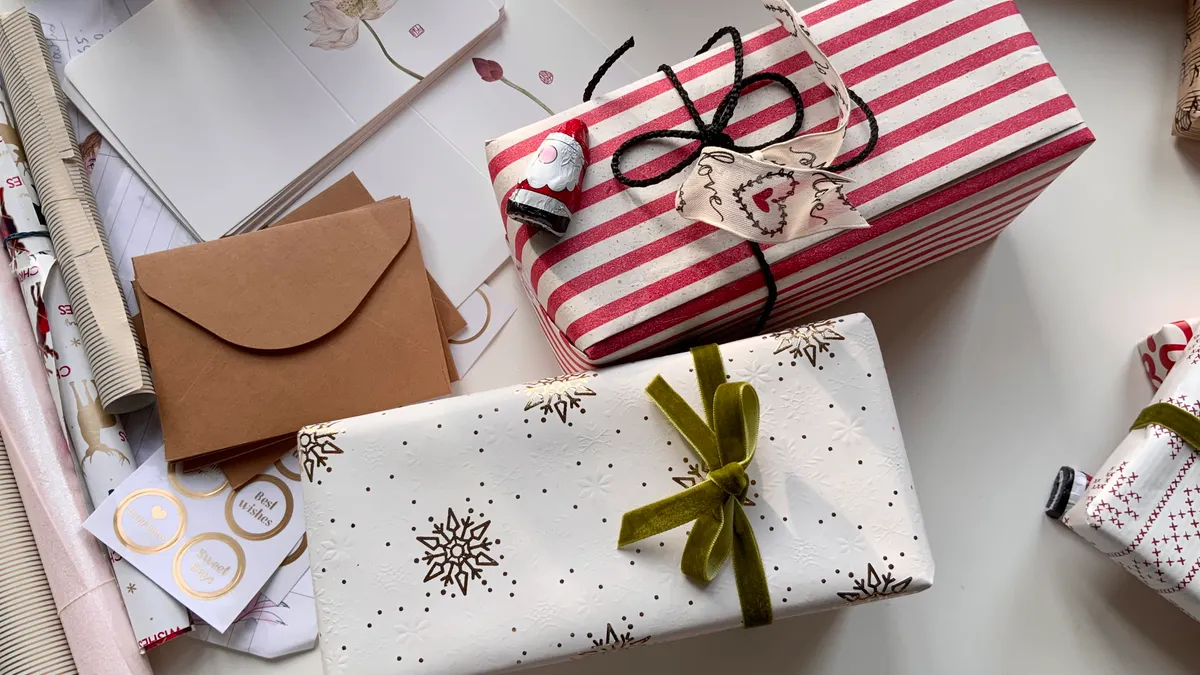
The core gift wrapping tools and accessories are a sharp cutter, a pair of dedicated scissors, tape, a ruler or cutting mat, and a storage system. Everything else is optional until your volume or paper type makes it necessary.
Most people start by buying decorative accessories first and functional tools last. That order is backward. A roll of beautiful paper still looks messy if the tape fails, the edges split, or the cut wanders. The basics do the unglamorous work: they keep seams straight, corners crisp, and paper from shredding under pressure.
The single most useful tool for regular wrapping is a clean cutting edge. For many people that means a rotary cutter on a self-healing mat, or a long paper trimmer if the workspace allows it. Both give a straighter cut than household scissors on long rolls. A ruler helps for box math, especially on square or rectangular parcels where you want even overlap. Double-sided tape is another quiet upgrade; it hides seams and keeps the front of the package cleaner than visible tape strips.
The main limitation is cost and space. A rolling cutter, mat, and trimmer take more room than a kitchen drawer. If you only wrap a few packages at holidays, the return on a big station is low. In that case, a good pair of scissors, a dispenser with sharp blades, and a roll of quality tape are enough.
The tools matter most when paper is unforgiving. Metallic papers wrinkle easily. Thin kraft paper tears at the corners. Heavy-coated paper resists folds but shows every miscut. Those are the conditions where better tools change the result.
For a quick comparison, there are 4 practical levels of setup: bare basics, a compact kit, a dedicated station, and a batch-wrapping setup. The right level depends on how many gifts you wrap in a season, not on how many accessories look appealing online.
Which wrapping tools are worth buying first?
Buy tape, scissors, and a cutting surface first; buy decorative gadgets last. That order gives the biggest improvement for the least money and storage.
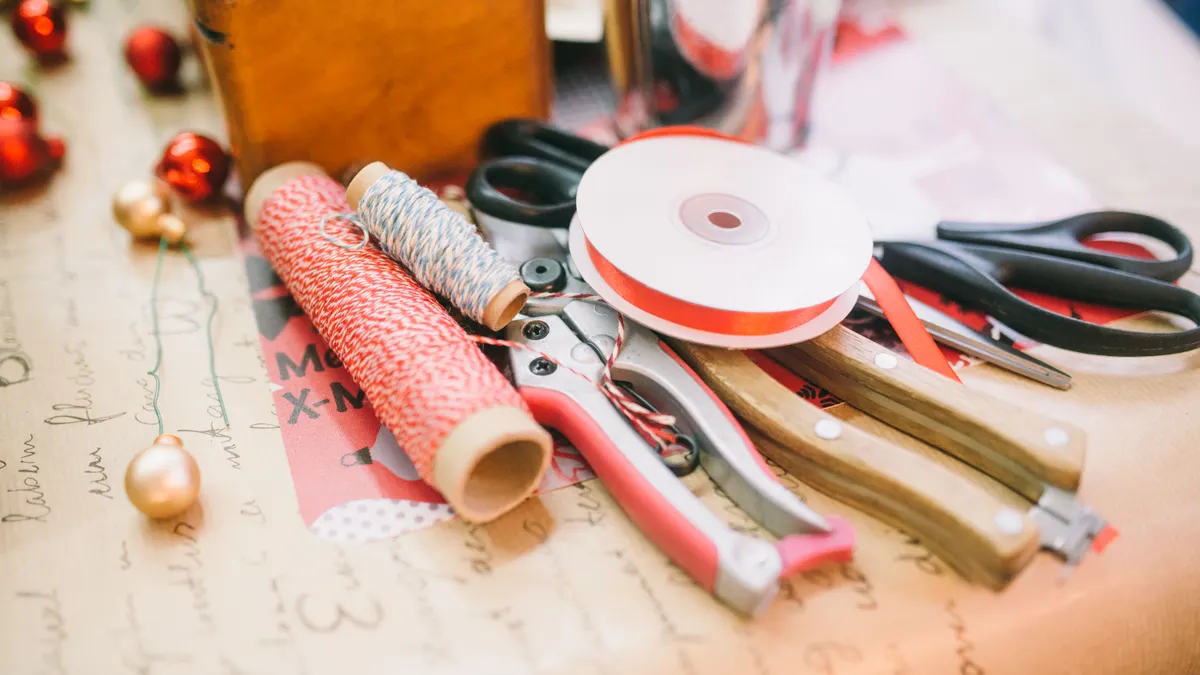
A useful starter kit is simple: one strong pair of scissors used only for paper, one tape dispenser or roll of quality transparent tape, one roll of double-sided tape, and a measuring surface such as a cutting mat with a grid. A ruler or straightedge belongs in the same group. If you wrap boxes often, a bone folder can help press creases cleanly, but it is not a must-have for beginners.
The case for scissors is straightforward. A dedicated pair stays sharper because it does not cut food, cardboard scraps, or plastic ties. Blades that are even slightly dull crush gift wrap fibers and leave ragged edges. A tape dispenser matters because a roll that constantly curls back on itself slows the job and invites wrinkles. A cutting mat matters because it gives you a protected surface and a visible grid, which helps with repeatable measurements.
The mistake most people make is buying decorative extras before the boring gear. A ribbon curl tool, sticker pack, or fancy tag punch does not fix crooked corners. Good tools fix the part of wrapping that viewers notice first: clean edges and flat seams.
Here is a practical first-buy list for many homes:
- paper scissors
- tape dispenser or roll of high-tack tape
- double-sided tape
- 24-inch or larger cutting mat
- metal ruler or straightedge
- storage bin or bag for rolls
Skip specialized cutters if you only need them once in a while. A trimmer becomes worthwhile when you regularly wrap multiple gifts in one session or use long sheets that are tedious to cut by hand. For example, a 24-inch mat is large enough to support many box corners without taking over an entire table.
The honest side-by-side: basic tools vs. a wrapping station
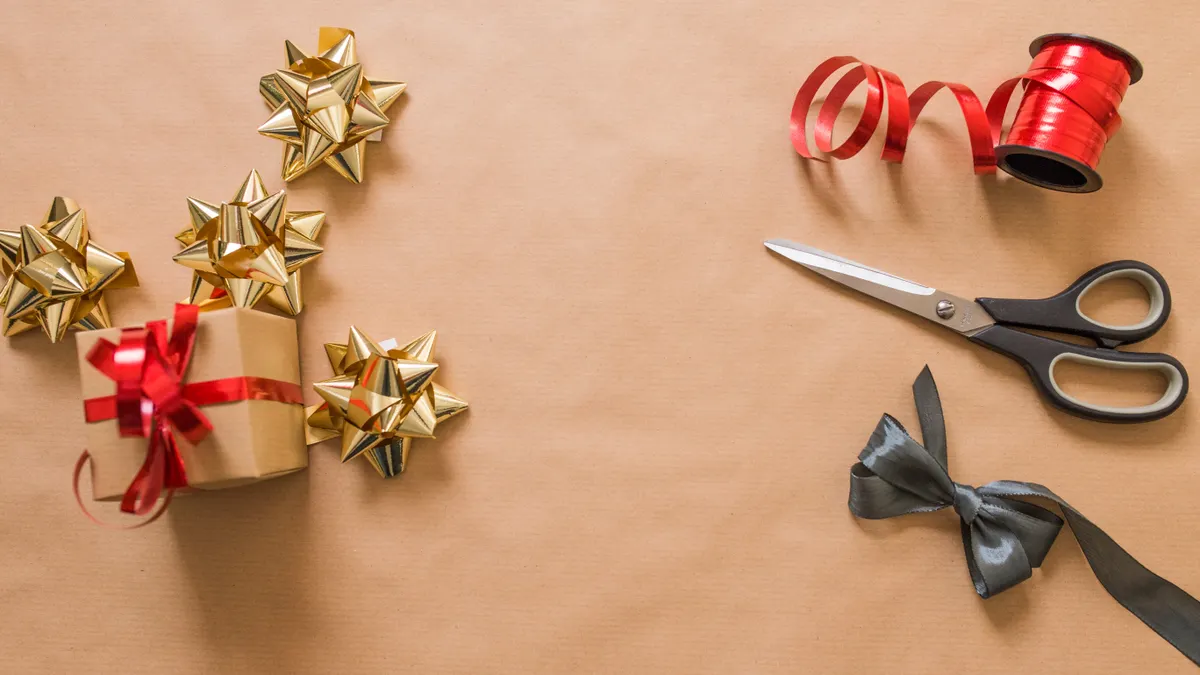
Basic tools win for small households; a wrapping station wins for frequent wrappers, because it cuts setup time and keeps long rolls under control.
| Criteria | Basic tools | Wrapping station | Winner for [condition] |
|---|---|---|---|
| Space needed | Fits in a drawer or bin | Usually needs a shelf, table, or closet section | Basic tools for apartments and small homes |
| Setup time | Fast to grab and use | Faster once assembled, slower to install | Basic tools for occasional wrappers |
| Cut quality | Depends on scissors and straightedge | Usually cleaner with a built-in cutter or trimmer | Wrapping station for long paper cuts |
| Storage for rolls | Loose storage in a basket or tube | Often includes dedicated slots or rods | Wrapping station for several rolls, tags, and ribbon spools |
| Portability | Easy to move from room to room | Usually stays in one place | Basic tools for shared spaces |
| Cost outlay | Lower entry cost | Higher because of frame, cutter, or organizer features | Basic tools for budget-conscious buyers |
| Best for paper volume | Light to moderate wrapping | Medium to heavy wrapping volume | Wrapping station for holiday-heavy homes |
| Precision for repeat jobs | Good if the user is careful | Better for repeated box sizes and long runs | Wrapping station for batch wrapping |
| Risk of clutter | Low if kept in one bin | Higher if the station becomes a permanent eyesore | Basic tools for minimalist storage |
The right choice depends on how often you wrap and how much room you can spare. A basic setup is enough for birthdays, a few holidays, and the occasional box. A wrapping station makes sense when wrapping becomes a seasonal project with 10 or more gifts, several rolls, and a need to keep ribbon, tags, and tape in one place.
The weakness of a station is not performance; it is commitment. If the station is awkward to store or too large for the room, it turns a simple task into a maintenance problem. The weakness of basic tools is inefficiency: more repeated cutting, more searching for supplies, and more visible tape if the accessories are too plain.
According to the U.S. Postal Service, packages should be wrapped in plain paper and secured with one strip of pressure-sensitive tape on each seam; that advice is a useful reminder that clean materials and simple tools often beat elaborate decoration. The USPS also notes that a parcel should be able to survive handling, which is another reason to choose tape and cutters that work cleanly.
How do you choose tape, ribbon, and tags without buying junk?
Choose tape by holding power, ribbon by material, and tags by readability; the wrong decorative accessory can make the whole package look worse.
Tape sounds boring until it fails. Standard clear tape works for light wraps, but double-sided tape is cleaner on the front of the package because seams stay hidden. For heavier paper or larger gifts, stronger tape is less frustrating because corners stay down instead of springing loose. If the dispenser blade is dull, even a good roll becomes annoying to use. That is why dispenser quality matters as much as tape quality.
Ribbon is where people overspend fastest. Wire-edged ribbon holds shape better for bows and layered loops, which makes it useful for boxed gifts and display-oriented wrapping. Satin ribbon looks softer but can slide and flatten. Twine and jute fit rustic kraft paper, though they do not hold a formal bow as well. Narrow ribbon is easier to curl; wide ribbon gives more visual weight. For a clean look, match ribbon width to the size of the box. A 3/8-inch ribbon can vanish on a large parcel, while a 1.5-inch ribbon can overwhelm a small box.
Tags should solve a practical problem first: who the gift is for and how to read the name at a glance. If the handwriting is small or the tag shape is fussy, the tag becomes decoration instead of information. Simple rectangular or scalloped tags usually work better than oversized novelty shapes.
The hidden trade-off is waste. Metalized ribbons, layered bows, and heavily textured tags are attractive, but they create more leftover scraps and can take longer to attach cleanly. If the goal is speed, use one ribbon type and one tag style across the pile. That keeps the wrapping set consistent and reduces decision fatigue.
The tools that help most with different wrapping materials
Kraft paper likes a bone folder and double-sided tape; glossy paper needs a sharp cutter; tissue paper needs a light hand and low-tack support.
The material you wrap matters more than most generic gift guides admit. A tool that works beautifully on one paper type can be awkward on another.
Kraft paper is forgiving, but it shows bad folds if the corners are crushed by hand. A bone folder helps make neat creases, especially at the edges of boxes and the ends of tubes. Double-sided tape keeps seams discreet and avoids the puckering that visible tape strips can create on matte paper. Kraft paper is also heavy enough that a slightly stronger tape is useful.
Glossy or coated paper is the opposite. It looks polished, but it can show fingerprints, scuffs, and crooked cuts instantly. Here a sharp blade matters more than decorative tools. Scissors that drag across the surface can leave an ugly edge. A rotary cutter on a mat or a long paper trimmer gives a cleaner line.
Tissue paper tears easily, so the tool set should be gentle. Small pieces of low-tack tape, often used to secure tissue inside bags, help without ripping the sheet. Heavy tape can damage the paper. If the tissue is meant to line a gift bag or wrap fragile items, less force is better. For delicate tissue, a careful hand and a small amount of tape are usually safer than a heavy seal.
Fabric wraps such as furoshiki-style cloth need a different mindset altogether. Scissors matter less than knotting skill, and tags or ribbon may be unnecessary. In that case, a reusable tie or clip can be a sensible accessory. That is a good reminder that not all gift wrapping should be solved with the same toolset.
When a specialty tool earns its place
A specialty tool earns its place only when it removes a repeated frustration, such as long cuts, box sizing, or ribbon finishing.
This is where many wrapping purchases go wrong. A novelty bow maker, corner punch, or label gadget can be satisfying for one afternoon and useless after that. The exception is when the same annoyance appears every season or every batch of gifts. Then a specialty tool can pay for itself in saved time and cleaner output.
The most practical specialty tool for many households is a paper trimmer or rolling cutter. It helps when you regularly cut large sheets or trim long sections off a roll. The benefit is repeatability: one straight pass instead of several cautious snips. For crafters who wrap in batches, that matters.
A bow maker can be useful if presentation matters and the same size bow appears on many boxes. It gives structure to loops and makes repeat shapes easier. The drawback is storage and learning curve. If you only need one or two bows, hand-forming them is faster.
A ribbon cutter or heat-sealing tool may help some synthetic ribbons resist fraying, but not every home needs it. If the ribbon is wired, wired ends are already easier to manage. If the ribbon is satin or polyester and frays badly, a cleaner cut edge or lighter handling may be enough.
Corner tools and gift wrapping templates are more niche. They can help with uniform folds, but they do not rescue poor paper quality or bad tape. They are best for people who wrap many similarly sized boxes and care about matching edges. They are not a fix for inconsistent materials.
The rule is simple: buy a specialty tool only when the same problem has appeared three or four times, not after one frustrating afternoon.
What should be in a sensible gift wrapping kit?
A sensible kit includes six items: scissors, tape, double-sided tape, ruler or mat, ribbon, and tags, with storage added if you wrap more than a few gifts a year.
That is the practical minimum for most homes. It covers cutting, attaching, measuring, finishing, and labeling without pushing you into unnecessary gear. If space is tight, keep the kit in one shallow bin or a long storage case so you do not have to hunt through multiple drawers.
For a compact setup, choose:
- one dedicated pair of scissors
- one roll of clear tape or a dispenser
- one roll of double-sided tape
- one 12×18-inch or larger cutting mat, if the table allows it
- one neutral ribbon type
- one pack of simple tags
- one storage bin or portfolio for paper rolls
For a more serious setup, add a long paper trimmer, a bone folder, and a box organizer for bows, labels, and small embellishments. That tier makes sense if you wrap at least a seasonal batch and want the station ready to go. The bigger the paper rolls, the more important storage becomes, because crumpled edges and bent tubes ruin the first cut before wrapping even starts.
The wrong kit is the one built from isolated impulse buys. A label punch without labels, a bow maker without ribbon, or a roll holder with no room for the rolls themselves creates clutter and disappointment. A better kit has one job: make the next gift easier than the last one.
When should you skip the accessories altogether?
Skip the accessories when you wrap rarely, travel with gifts, or use small bags instead of paper.
This is the clearest part of the guide: not every gift needs a full wrapping system. If you wrap two or three presents a year, the time spent organizing specialty tools may exceed the time saved. A bag, tissue, and card can be enough. If gifts are mailed rather than hand-delivered, a decorative setup can also be wasteful because the package will be handled and flattened in transit.
There are other cases where accessories are not the answer. If the paper is too thin, the box too oddly shaped, or the gift too fragile, more tools will not make the job better. A gift bag with tissue or a reusable fabric wrap may produce a cleaner result with less effort.
The biggest caution is this: don’t let accessory shopping become a substitute for learning a few simple wrapping moves. Straight cuts, tucked corners, clean tape placement, and measured overlap matter more than novelty tools. A person who can wrap cleanly with scissors and tape will get better results than someone with a drawer full of gadgets and no system.
The verdict: what to buy and what to ignore
Choose a basic tool kit if you wrap a few gifts a year and store supplies in a small space. Choose a wrapping station if you wrap in batches, want cleaner long cuts, and have room for dedicated storage. Neither if you mostly use gift bags, mail gifts, or hate storing seasonal supplies.
That is the cleanest recommendation. Start with scissors, tape, double-sided tape, and a ruler or mat. Add ribbon and tags only after those basics are working. Move up to a station or paper trimmer only when repeated wrapping jobs make the upgrade useful.
For most readers, the smartest purchase is not the fanciest accessory. It is the tool that removes the most annoying step.
What do I need for a clean gift wrap finish?
You need a sharp cutter, reliable tape, and a flat surface, then a simple ribbon or tag if you want the package to look finished. A 24-inch cutting mat or a long straightedge makes the biggest difference for box-shaped gifts because it helps keep the cuts square and the folds even.
The finish depends on three things: the cut, the seam, and the label. If any one of those is sloppy, the whole package looks rushed. Sharp scissors or a trimmer reduce ragged edges. Double-sided tape hides the seam. A readable tag or restrained ribbon finishes the look without crowding the package.
For a polished result, keep the number of embellishments low. One ribbon and one tag usually beat three different decorative elements fighting for attention. That rule matters especially on patterned or metallic paper, where too many accessories make the gift look busy rather than careful.
What is the most useful gift wrapping accessory for beginners?
Double-sided tape is the most useful accessory for beginners because it hides seams and reduces the visible mess that makes wrapped gifts look amateurish. A roll of standard tape is still necessary, but the hidden tape does more for appearance.
Beginners often struggle with tape placement, not paper folding. Double-sided tape gives more forgiveness because the visible face stays clean. It also helps on the closing flap of a box or the overlap on a paper sleeve, where a visible strip would interrupt the design.
If the budget allows only one upgrade beyond scissors, choose the tape upgrade. If there is room for two, add a cutting mat with grid marks. That combination solves the most common beginner problems: crooked cuts and obvious seams.
Which accessories are not worth the money for most people?
Most novelty gadgets are not worth the money unless a specific wrapping problem keeps repeating. Bow makers, corner punches, and themed label tools often sound useful, but they usually solve a narrow problem that ordinary scissors, tape, and a ruler already cover.
The issue is not that these tools never work. It is that they are too specific for a general wrapping drawer. If one tool only helps with one style of gift once a year, it belongs in the “skip” pile unless the effect matters deeply to you. A stable setup should make wrapping easier every time, not only when the right accessory is on hand.
A good test is simple: if a tool does not save at least one step, one minute, or one common annoyance, it is probably decorative rather than essential. Decorative tools are fine if presentation is the hobby. They are poor buys if the goal is efficient, attractive wrapping with minimal clutter.
How should you store wrapping tools and accessories?
Store gift wrapping tools and accessories in one dedicated container, because scattered supplies cause more waste than missing supplies do. A long bin, under-bed box, or upright portfolio works better than a loose drawer full of rolls, tags, and partial tape.
Storage matters because wrapping supplies deform easily. Paper rolls bend, ribbon tangles, and tags disappear into the bottom of baskets. Keep sharp tools together in a case or sleeve. Keep tape in one place so the dispenser does not vanish. If the setup includes a mat or trimmer, store it flat or upright where it will not warp.
The best storage choice depends on volume. For a handful of rolls, a clear bin is enough. For a serious wrapping station, a vertical organizer with compartments for paper, ribbon, and small accessories makes more sense. If the room is limited, a collapsible tote or zippered storage bag can hold the basics without taking over a closet.
The point of storage is not neatness for its own sake. It is speed. If the supplies are easy to reach, the wrapping gets done. If the supplies are buried, people switch to a gift bag and call it good.
Drafted with AI; not yet reviewed by a person.